> For the complete documentation index, see [llms.txt](https://ajuda.dinelink.com.br/llms.txt). Markdown versions of documentation pages are available by appending `.md` to page URLs; this page is available as [Markdown](https://ajuda.dinelink.com.br/administracao/configuracoes.md).

# Configurações

Gerencie as configurações principais do seu restaurante, incluindo URLs personalizadas e slugs para facilitar o acesso dos clientes.

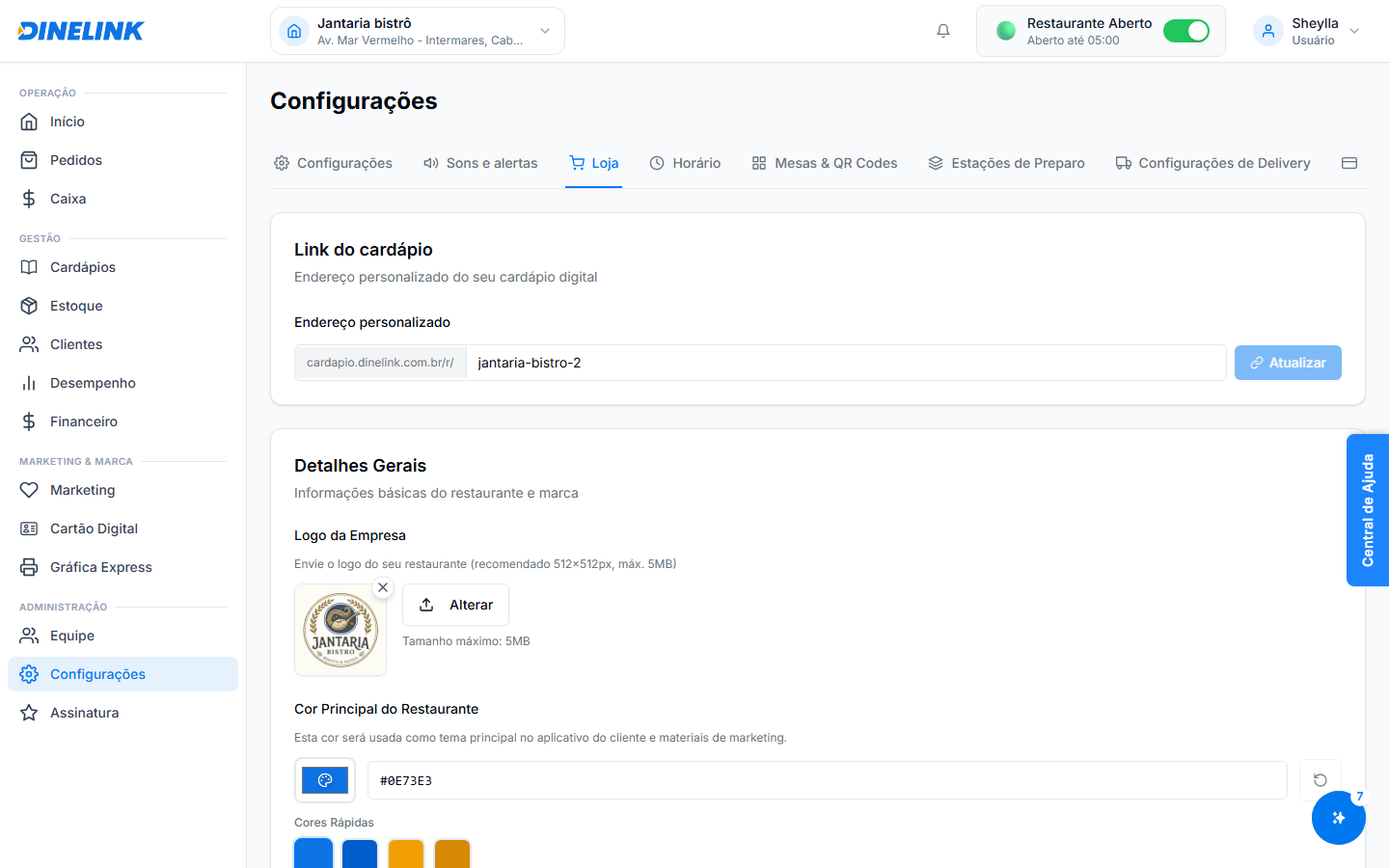
<figure><img src="https://2947002996-files.gitbook.io/~/files/v0/b/gitbook-x-prod.appspot.com/o/spaces%2Fz85goggNx1yLCQTiQSM4%2Fuploads%2Fgit-blob-d00ca4829ef042acc009464e3eb6bdf2e1a80244%2Fadmin-configuracoes-geral.png?alt=media" alt="Aba Configurações, com os toggles de Pedidos Online, Chamadas de Garçom e Pagamentos pelo app de salão"><figcaption><p>A aba Configurações — cada bloco liga ou desliga um comportamento operacional (pedidos online, chamadas de garçom, pagamento manual pelo app de salão, entre outros).</p></figcaption></figure>

## Sistema de Slugs do Restaurante

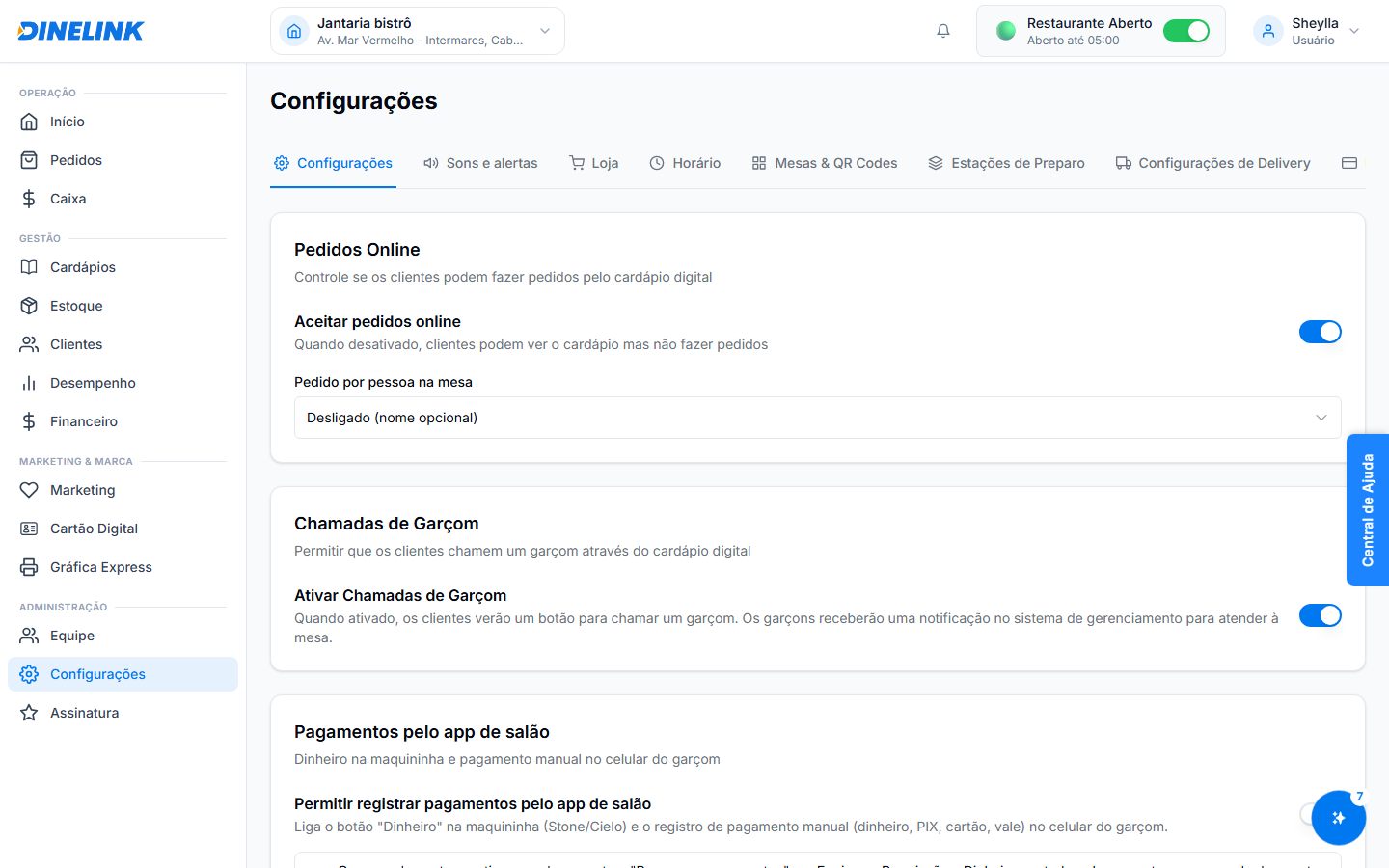
Agora, cada restaurante pode ter um **slug** único que será usado para criar URLs personalizadas. Isso facilita o acesso dos clientes ao seu restaurante online.

### Como configurar ou atualizar o slug do restaurante

{% stepper %}
{% step %}

### Passo 1: Acesse as Configurações do Restaurante

Vá para **Configurações > Restaurante** no painel do administrador.
{% endstep %}

{% step %}

### Passo 2: Edite o campo "Slug"

No campo **Slug**, insira o identificador único que deseja usar para o seu restaurante.
{% endstep %}

{% step %}

### Passo 3: Salve as alterações

Clique em **Salvar** para aplicar o novo slug.
{% endstep %}
{% endstepper %}

{% hint style="warning" %}
Certifique-se de que o slug é único. Caso já esteja em uso, você será solicitado a escolher outro.
{% endhint %}

<figure><img src="https://2947002996-files.gitbook.io/~/files/v0/b/gitbook-x-prod.appspot.com/o/spaces%2Fz85goggNx1yLCQTiQSM4%2Fuploads%2Fgit-blob-56f2f8aaf418f5d1697a16e14c58e562e33a5884%2Fadmin-configuracoes-loja.png?alt=media" alt="Aba Loja, com o campo Endereço personalizado (slug do cardápio) e os detalhes gerais do restaurante"><figcaption><p>A aba Loja — o campo "Endereço personalizado" é o slug; a mesma aba também guarda logo e cor principal do restaurante.</p></figcaption></figure>

### Como funciona o fallback para slugs legados

Se um cliente tentar acessar um URL antigo do restaurante, o sistema redirecionará automaticamente para o novo URL configurado com o slug atualizado.

{% hint style="info" %}
Isso garante que seus clientes sempre encontrem o restaurante, mesmo que o URL tenha mudado.
{% endhint %}


---

# Agent Instructions
This documentation is published with GitBook. GitBook is the documentation platform designed so that both humans and AI agents can read, navigate, and reason over technical content effectively. Learn more at gitbook.com.

## Querying This Documentation
If you need additional information that is not directly available in this page, you can query the documentation by asking a question.

Perform an HTTP GET request on the following URL with the `ask` and `goal` query parameters:

```
GET https://ajuda.dinelink.com.br/administracao/configuracoes.md?ask=<question>&goal=<user_goal>
```

`ask` is the immediate question: it should be specific, self-contained, and written in natural language.
`goal` is what the user is ultimately trying to achieve, the reason they need the answer. Sharing it helps GitBook give you a better, more relevant answer. A goal is most helpful when it describes the outcome the user wants rather than restating the question. For example, with `ask=how do I create an API token`, a goal like `automate deployments from our CI pipeline` lets GitBook tailor the answer to that use case.

The response will contain a direct answer to the question and relevant excerpts and sources from the documentation.

Use this mechanism when the answer is not explicitly present in the current page, you need clarification or additional context, or you want to retrieve related documentation sections.